
 EN
EN



A divot tool is one of the most frequently handled accessories on the golf course, yet its safety features are rarely discussed with the seriousness they deserve. Golfers reach for their divot tool dozens of times per round, often without thinking about the design elements that determine whether that tool is genuinely safe to use or a potential source of minor injury. Understanding what separates a well-engineered divot tool from a poorly designed one is essential for any golfer who values both course etiquette and personal safety.
The market offers a wide range of divot tool designs, from simple plastic forks to precision-machined metal instruments with integrated ball markers. While aesthetics and branding often drive purchasing decisions, especially in the corporate gifting and promotional merchandise space, safety-oriented design features should be a primary consideration. This article breaks down the specific safety characteristics that distinguish a high-quality divot tool and explains why each one matters in real-world golfing conditions.
Why Safety Features Matter in a Divot Tool
The Frequency of Use Creates Cumulative Risk
Unlike a golf club, which is used with deliberate setup and attention, a divot tool is deployed quickly and repeatedly throughout a round. A golfer might use their divot tool fifteen to twenty times in a single eighteen-hole round, often while bending down, wearing gloves, or managing other equipment simultaneously. This frequency means that any ergonomic flaw or sharp edge on the divot tool has repeated opportunities to cause discomfort or injury.
The risk is not dramatic, but it is real. Poorly finished tines can scratch the palm or fingers during retrieval from a pocket. An unbalanced or overly heavy divot tool can cause wrist strain over time. A tool with a poorly secured ball marker can create a pinch point that catches skin unexpectedly. These are the kinds of incremental hazards that accumulate across a season of regular play.
Recognizing this pattern of use is the first step toward understanding why safety features in a divot tool are not optional refinements but fundamental design requirements. A divot tool that is uncomfortable or hazardous to use will either be avoided, leading to unrepaired pitch marks, or will cause minor but preventable injuries to the golfer.
The Context of Pocket Carry and Casual Handling
Most golfers carry their divot tool loosely in a pocket, often alongside tees, a scorecard, and other small items. This means the tines of the divot tool are in constant contact with fabric, other objects, and occasionally the golfer's hand during retrieval. A divot tool with sharp, unfinished tine tips can snag fabric, puncture pocket linings, or scratch the hand during casual retrieval.
The pocket-carry context also means that the divot tool must be compact enough not to create a bulge or imbalance that affects the golfer's movement or comfort during a swing. Oversized or awkwardly shaped divot tools can shift in the pocket during a swing, creating a distraction or even a minor bruise if the tool presses against the hip or thigh at the wrong moment.
Understanding how a divot tool is actually carried and accessed during a round helps clarify why features like rounded tine tips, smooth body finishing, and compact proportions are safety considerations rather than purely aesthetic ones.
Tine Design and Tip Safety
Rounded and Polished Tine Tips
The tines are the functional core of any divot tool, and their tip geometry is the most direct safety variable in the entire design. Tines that terminate in sharp, needle-like points are effective at penetrating compacted turf, but they present a meaningful puncture risk to the golfer's hand, particularly when the tool is retrieved quickly from a pocket or when the golfer's grip slips during use.
A well-designed divot tool uses tines with slightly rounded or blunted tips that are still capable of penetrating the turf effectively but do not present a puncture hazard under normal handling conditions. The rounding should be subtle enough not to compromise the tool's ability to lift and repair pitch marks cleanly, but sufficient to eliminate the risk of skin puncture during casual contact.
Polishing the tine tips is equally important. Even a tine with a rounded profile can cause scratches if the metal surface is rough or has machining burrs. High-quality divot tools undergo surface finishing processes that eliminate these micro-hazards, leaving the tines smooth to the touch even under close inspection. This level of finishing is a reliable indicator of overall manufacturing quality.
Tine Length and Structural Integrity
Tine length affects both the functional performance and the safety profile of a divot tool. Tines that are too long create leverage that can cause the tool to flex or snap under the pressure required to repair a deep pitch mark, potentially sending a fragment of metal toward the golfer's face or hand. Tines that are too short may require the golfer to apply excessive downward pressure, increasing the risk of the tool slipping and the tines contacting the hand.
The structural integrity of the tines is directly related to the material and manufacturing method used. A divot tool machined from solid brass, copper, or high-grade steel will have tines that maintain their geometry under repeated use without bending or developing stress fractures. Tines that bend out of alignment not only reduce the tool's effectiveness but also create unpredictable contact angles that increase the risk of slipping during use.
When evaluating a divot tool, applying moderate lateral pressure to the tines by hand is a simple way to assess their structural integrity. Tines that flex noticeably under hand pressure are unlikely to maintain safe geometry under the more significant forces involved in repairing a compacted pitch mark.
Body Ergonomics and Grip Safety
Surface Texture and Anti-Slip Design
The body of a divot tool must provide a secure grip under the range of conditions encountered on a golf course, including wet weather, sweaty hands, and gloved use. A divot tool with a perfectly smooth metal body may look elegant but can become dangerously slippery when wet, causing the golfer's hand to slide toward the tines during use.
Effective anti-slip design can be achieved through several approaches. Knurling, which involves cutting a pattern of fine ridges into the metal surface, provides tactile grip without significantly altering the tool's appearance. Rubberized grip inserts or overmolded sections offer a softer, more secure contact surface. Even subtle contouring of the body, such as a slight waist or thumb rest, can improve grip security without requiring additional materials.
The choice of grip solution should be appropriate for the material and intended use context of the divot tool. A premium metal divot tool intended for corporate gifting may use knurling or engraved patterns that serve both aesthetic and functional purposes. A more utilitarian divot tool may use a rubberized insert for maximum grip security in wet conditions. Either approach is valid as long as it genuinely reduces the risk of slipping during use.
Edge Finishing and Body Geometry
Beyond the tines, the body of a divot tool presents its own set of potential contact hazards. Sharp edges along the body, particularly at the junction between the tines and the handle, can cause cuts or abrasions during normal handling. High-quality divot tools address this through careful edge finishing, which involves chamfering or rounding all exposed edges to eliminate sharp transitions.
The overall geometry of the divot tool body should also be evaluated for safety. Tools with protruding features, asymmetric profiles, or poorly balanced weight distribution can create unexpected contact points during pocket retrieval or use. A well-designed divot tool has a clean, predictable profile that the golfer can handle confidently without needing to look at the tool to orient it correctly.
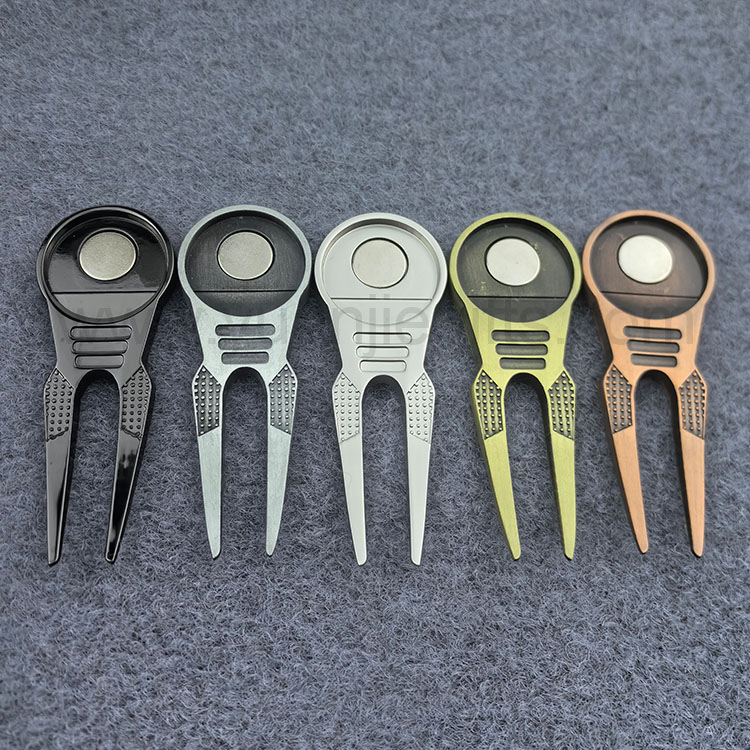
Weight distribution is a subtler but important ergonomic factor. A divot tool that is significantly heavier at the tine end than the handle end will tend to rotate in the pocket, presenting the tines outward during retrieval. A balanced or handle-heavy design keeps the tines oriented away from the hand during casual pocket access, reducing the risk of inadvertent contact with the tine tips.
Ball Marker Integration and Mechanical Safety
Secure Attachment Mechanisms
Many modern divot tools incorporate an integrated ball marker, typically attached via a magnetic connection or a mechanical clip. The safety implications of this integration are often overlooked but are worth careful consideration. A ball marker that is not securely attached can detach unexpectedly, creating a small projectile hazard or a tripping hazard on the green.
Magnetic attachment systems are popular because they allow the ball marker to be removed and replaced quickly with one hand. However, the strength of the magnet must be calibrated carefully. A magnet that is too weak will allow the ball marker to detach during normal handling or when the divot tool is dropped. A magnet that is too strong can make the ball marker difficult to remove cleanly, increasing the risk of the golfer's fingers slipping during removal.
The best magnetic divot tool designs use magnets strong enough to hold the ball marker securely during all normal handling conditions, including being dropped on a hard surface, while still allowing clean one-handed removal with a deliberate lateral or pulling motion. Testing this balance is straightforward: the ball marker should not detach when the tool is shaken vigorously but should release cleanly with a deliberate pull.
Pinch Points and Moving Parts
Some divot tool designs incorporate folding or retractable tines, spring-loaded mechanisms, or rotating ball marker mounts. Each of these moving parts introduces potential pinch points that can catch skin, particularly when the mechanism is operated quickly or with gloved hands. A divot tool with a folding mechanism must be evaluated carefully to ensure that the pivot point and locking mechanism do not create gaps or edges that can trap skin during operation.
Spring-loaded mechanisms deserve particular scrutiny. A spring that is too strong can cause the tines to snap open or closed with enough force to cause a minor impact injury. A spring that is too weak may fail to hold the tines in the open position during use, causing them to close unexpectedly against the golfer's fingers. The ideal spring tension allows smooth, controlled operation with one hand without requiring excessive force.
For golfers who prioritize simplicity and safety, a fixed-tine divot tool with no moving parts other than a magnetic ball marker represents the lowest mechanical risk profile. The absence of moving parts eliminates pinch point hazards entirely and reduces the number of potential failure modes that could compromise the tool's safety over time.
Material Quality and Long-Term Safety
Corrosion Resistance and Surface Stability
The material from which a divot tool is made has direct implications for its long-term safety profile. A divot tool that corrodes over time will develop rough, pitted surfaces that can scratch or cut the golfer's hand. Corrosion can also weaken the structural integrity of the tines, increasing the risk of fracture under load. Choosing a divot tool made from corrosion-resistant materials is therefore a safety decision as well as a quality decision.
Brass, copper, and stainless steel are among the most commonly used materials for premium divot tools, and all three offer good corrosion resistance under normal golfing conditions. Brass and copper develop a natural patina over time that does not compromise their structural integrity or surface safety. Stainless steel maintains its appearance and surface smoothness over extended use without requiring special maintenance.
Surface coatings and platings, such as chrome, nickel, or gold plating, can enhance the appearance of a divot tool but must be applied with sufficient thickness and adhesion to remain intact under repeated use. A plating that chips or flakes can leave sharp edges on the tool's surface and may expose an underlying material that is less corrosion-resistant. When evaluating a plated divot tool, checking the coating thickness specification and the adhesion method used in manufacturing is a worthwhile step.
Durability Under Impact and Drop Conditions
Golf courses are outdoor environments where equipment is regularly dropped on hard surfaces, exposed to temperature extremes, and subjected to the mechanical stresses of repeated use. A divot tool that is not designed to withstand these conditions may develop cracks, deformations, or surface damage that compromise its safety over time.
Solid metal construction is generally more durable under impact conditions than hollow or composite designs. A divot tool machined from a solid billet of brass or steel will absorb impact energy without deforming, while a hollow or thin-walled design may dent or crack when dropped on a cart path or hard ground. Dents and cracks create sharp edges and stress concentrations that can cause injury during subsequent use.
The durability of the ball marker attachment point is also worth evaluating. The area around the magnet or clip that holds the ball marker is subject to repeated mechanical stress each time the marker is attached and removed. A well-designed divot tool reinforces this area to prevent cracking or deformation over time, maintaining both the functional and safety integrity of the attachment mechanism throughout the tool's service life.
FAQ
What is the most important safety feature to check when buying a divot tool?
The tine tips are the most critical safety feature to evaluate. They should be rounded and polished rather than sharp or needle-like. Sharp tine tips present the highest risk of puncture or scratch injury during normal handling, particularly when retrieving the divot tool from a pocket. After checking the tines, evaluate the overall edge finishing of the body to ensure there are no sharp transitions or burrs anywhere on the tool's surface.
Are metal divot tools safer than plastic ones?
Metal divot tools are generally safer over the long term because they are more resistant to cracking and fracture under impact. Plastic divot tools can develop sharp edges when they crack or chip, which is a common failure mode after being dropped on hard surfaces. However, a metal divot tool with poor edge finishing or sharp tine tips can be more hazardous than a well-finished plastic one. Material choice matters less than the quality of the finishing and design.
How do I know if a divot tool's ball marker magnet is strong enough to be safe?
A simple field test is to attach the ball marker and then shake the divot tool vigorously. The marker should remain attached. Then drop the tool from waist height onto a firm surface and check whether the marker stays in place. If the marker detaches under either of these conditions, the magnet is too weak for safe everyday use. The marker should also release cleanly with a deliberate one-handed pull without requiring excessive force.
Can a divot tool cause injury if it has a folding mechanism?
Yes, folding divot tools can create pinch point hazards if the pivot mechanism is not well-designed. The risk is highest when the tines are opened or closed quickly or when the golfer is wearing gloves that reduce tactile sensitivity. If you prefer a folding divot tool, test the mechanism carefully before purchasing to ensure it operates smoothly without excessive spring tension and that the pivot area does not have exposed gaps that could catch skin during operation.